 By
By 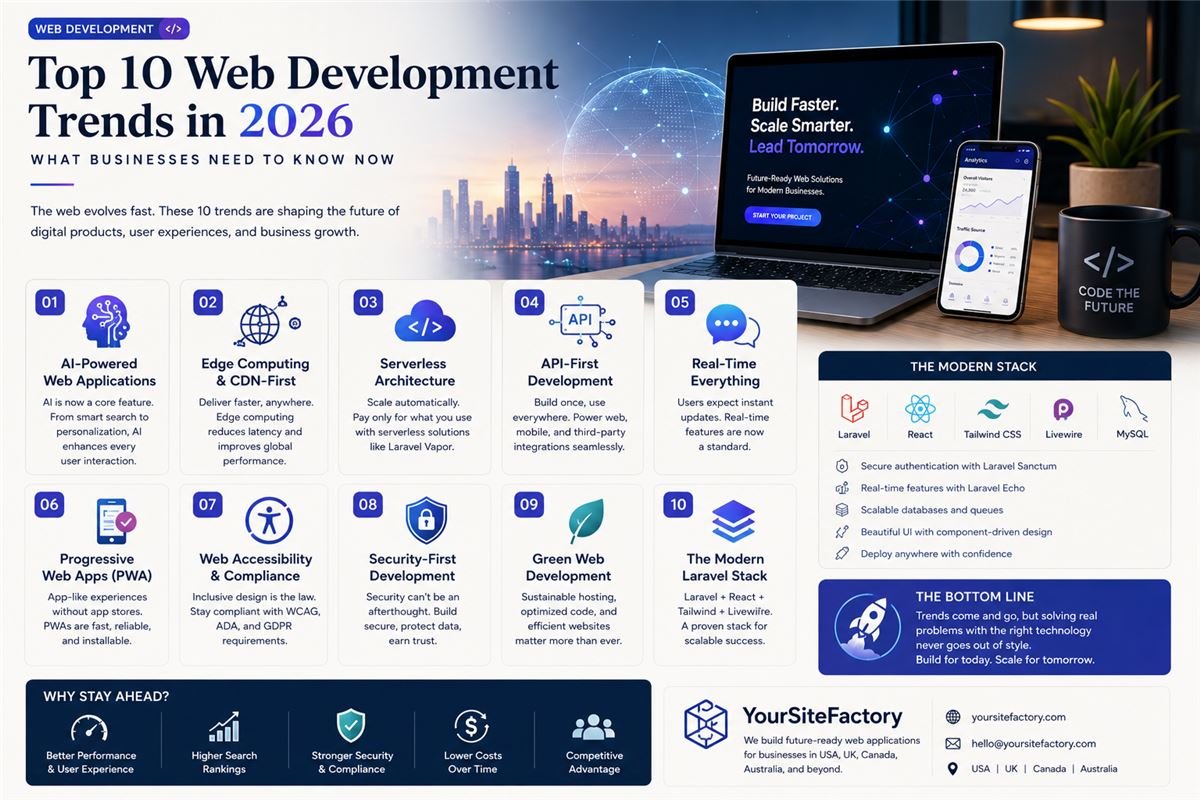
The web development landscape changes faster than almost any other technology field. What was considered advanced architecture in 2024 is standard practice in 2026. What was optional is now expected. What was a competitive advantage is now a baseline requirement.
Staying current with these trends is not about being trendy. It is about building applications that perform at the speeds users demand, scale without expensive rewrites, meet legal requirements that carry real financial penalties, and compete effectively against businesses that are already implementing these approaches.
Here are the ten most important web development trends shaping 2026 with practical implications for every business building or maintaining a web application.
1. AI-Powered Web Applications From Feature to Expectation
Artificial intelligence integration has crossed the line from competitive differentiator to user expectation. In 2024, an AI-powered feature was a selling point. In 2026, its absence is a reason users choose a competitor.
The applications that are winning in their markets share a common characteristic they use AI to make the core user experience faster and more relevant rather than bolting AI onto the side as a chatbot.
What AI integration looks like in production applications in 2026:
- Personalised content and recommendations showing users what they are most likely to engage with based on behaviour, not just category filters
- Intelligent search semantic search that understands intent rather than matching exact keywords
- Automated content assistance helping users write, categorise, and structure content inside your application
- Predictive analytics in dashboards surfacing anomalies and trends before users have to look for them
- AI-powered customer support handling routine queries with context-aware responses, escalating complex issues to humans
Implementation reality for Laravel and React applications:
You do not need to build AI from scratch. Laravel integrates cleanly with the OpenAI API, Anthropic's Claude API, and purpose-built AI packages like Prism PHP. A Laravel backend can make API calls to these services, process responses, and return intelligent results to a React frontend in the same request lifecycle as any other feature.
The practical starting point for most applications is adding semantic search and a context-aware assistant. These two features cover the majority of use cases that business users actually value.
2. Edge Computing and CDN-First Architecture
Traditional web architecture places your application server in one physical location. When a user in London requests a page from a server in New York, the data travels across the Atlantic and back adding 80–150 milliseconds of latency that compounds across every resource the page loads.
Edge computing solves this by running application code at data centres distributed globally. Your code executes at the location closest to each user rather than at a single origin server.
Why this matters for businesses targeting multiple markets:
For companies targeting the USA, UK, Canada, and Australia simultaneously a profile that describes most ambitious web businesses in 2026 edge computing transforms the international user experience. A user in Sydney gets sub-100ms response times from the same application that serves users in London and New York.
The practical implementation options:
- Cloudflare Workers run JavaScript at Cloudflare's 300+ global edge locations
- Vercel Edge Functions deploy Next.js applications with automatic edge distribution
- AWS CloudFront with Lambda@Edge attach serverless functions to CDN responses
- Laravel Vapor serverless Laravel deployment on AWS with built-in global distribution
The threshold for adopting edge architecture has dropped significantly. What required significant DevOps expertise in 2023 is now achievable through managed platforms with minimal configuration.
3. Serverless Architecture and Laravel Vapor
Serverless computing removes server management from the development workflow entirely. You write application code, deploy it, and pay only for actual execution time. The infrastructure provisioning, scaling, patching, monitoring is handled by the cloud provider.
For Laravel applications specifically, Laravel Vapor has made serverless deployment mainstream. Vapor deploys your Laravel application to AWS Lambda, handling database connections via RDS Proxy, file storage via S3, queues via SQS, and caching via DynamoDB all configured through a single deployment file.
The business case for serverless Laravel:
A traditional server running 24/7 costs the same whether it serves 10 users or 10,000. A serverless application scales automatically to handle any traffic volume and costs near zero during low-traffic periods.
For startups and SaaS applications with variable traffic patterns low at launch, spikes as the product grows serverless eliminates the choice between overpaying for idle capacity or under-provisioning and suffering performance degradation during growth.
What serverless does not solve:
Long-running processes video encoding, bulk data processing, large report generation do not fit the serverless model well due to execution time limits. These are better handled by dedicated queue workers running on traditional servers alongside a serverless application.
4. API-First Development The Architecture Behind Modern Applications
API-first development means building your backend as a set of well-defined API endpoints before building any frontend. The backend typically Laravel exposes a REST or GraphQL API. The frontend React, Vue, or a mobile application consumes it.
This separation has become the dominant architecture for new web applications in 2026 for practical reasons that compound over time:
The same API powers everything. A single Laravel API can serve a React web application, an iOS app, an Android app, and third-party integrations simultaneously. You build the business logic once and every client benefits.
Independent scaling. Your API and your frontend can be scaled, deployed, and optimised independently. A spike in API traffic does not affect your CDN-served frontend assets.
Team efficiency. Frontend and backend teams work in parallel against a shared API contract. Neither team blocks the other waiting for the other layer to be ready.
The Laravel + React implementation:
Laravel Sanctum provides SPA authentication specifically designed for React frontends CSRF cookie-based authentication for same-origin requests, token-based authentication for mobile clients. One authentication system serves both use cases cleanly.
5. Real-Time Features Now a Baseline Expectation
Users in 2026 experience real-time applications daily Slack notifications, Google Docs collaborative editing, live sports scores, real-time trading dashboards. These experiences have recalibrated expectations across all web applications.
When a SaaS platform requires a page refresh to show new data, users notice. When notifications take 30 seconds to appear, users notice. What was acceptable in 2020 reads as broken in 2026.
What real-time means in practice:
- Live notifications appearing without page reload
- Collaborative document or data editing where multiple users see each other's changes instantly
- Real-time dashboard updates as underlying data changes
- Live chat and support interfaces
- Activity feeds that update as other users take actions
Implementation with Laravel Echo:
Laravel Echo with Pusher or the self-hosted Soketi makes WebSocket-based real-time features straightforward to implement on a Laravel backend. Broadcasting events in Laravel is a first-class feature you fire an event, and Echo delivers it to subscribed frontend clients in real time.
// Broadcasting a real-time event in Laravel
event(new OrderStatusUpdated($order));

// React frontend subscribes and receives instantly
Echo.channel(`orders.${orderId}`)
    .listen('OrderStatusUpdated', (data) => {
        setOrderStatus(data.status);
    });
What once required significant WebSocket infrastructure expertise now takes hours to implement correctly.
6. Progressive Web Apps (PWA) Reaching Mainstream Adoption
Progressive Web Apps are web applications that deliver native mobile app experiences installation to the home screen, offline functionality, push notifications, and camera access without requiring a separate native app or App Store distribution.
In 2026, PWA adoption has accelerated significantly because the value proposition has become impossible to ignore for many business types.
The business case for PWAs over native apps:
- Single codebase one PWA serves iOS, Android, and desktop users without three separate development tracks
- No App Store friction users can install from the browser without App Store approval processes or 30% revenue cuts
- SEO indexable unlike native apps, PWA content is crawlable and indexable by Google
- Significantly lower development cost one team, one codebase, one deployment pipeline
Where PWAs make the most commercial sense:
E-commerce applications with repeat customers who benefit from fast offline browsing and push notification promotions. SaaS tools used daily by mobile workers who benefit from home screen installation. Service business applications booking systems, ordering platforms where mobile usage is the primary interaction model.
7. Web Accessibility From Best Practice to Legal Requirement
Web accessibility designing and building for users with disabilities has crossed a critical threshold. It is no longer a best practice that progressive companies choose to follow. It is a legal requirement in the USA, UK, and EU with documented financial consequences for non-compliance.
The legal landscape in 2026:
- USA (ADA): Courts have ruled consistently that public-facing websites must meet WCAG 2.1 AA standards. Lawsuits against businesses for inaccessible websites have increased significantly year-over-year since 2020
- UK (Equality Act 2010): Requires service providers to make reasonable adjustments for disabled users inaccessible websites can constitute unlawful discrimination
- EU (European Accessibility Act): Came into force in 2025, requiring many private sector digital services to meet accessibility standards
What WCAG 2.1 AA compliance requires in practice:
- All images have meaningful alt text that describes their content to screen reader users
- Full keyboard navigation every interactive element reachable and operable without a mouse
- Colour contrast ratios meeting minimum thresholds (4.5:1 for normal text, 3:1 for large text)
- Form fields have associated labels that screen readers announce correctly
- Error messages are clear and associated with the field that triggered them
- Video content has captions
- No content flashes more than three times per second (seizure risk)
Build accessibility into your component library from the start rather than auditing and retrofitting after launch. Retrofitting accessibility violations in a large React application is significantly more expensive than implementing accessible patterns in components initially. Use automated tools Axe, Lighthouse accessibility audit, WAVE for continuous scanning alongside manual testing with actual screen reader software.
8. Security-First Development Clients Are Now Asking Before Hiring
Following a sustained period of high-profile data breaches and significantly stricter enforcement of GDPR and CCPA, security practices have moved from a background assumption to an explicit purchasing criterion.
In 2026, procurement teams at US and UK companies specifically ask about security practices, penetration testing cadence, and incident response plans before signing development contracts. Security is no longer something you demonstrate after winning the work it is part of how you win it.
What security-first development means architecturally:
- Threat modelling during the design phase identifying attack surfaces before writing code rather than auditing for vulnerabilities after launch
- Automated security scanning integrated into CI/CD pipelines every code push triggers dependency vulnerability checks and static analysis
- GDPR and CCPA compliance designed into data models from the start not retrofitted after the data architecture is established
- Penetration testing on a regular schedule not just at initial launch
The Laravel security baseline in 2026:
Every production Laravel application should have CSRF protection on all forms, prepared statements for all database queries, output escaping in all Blade templates, rate limiting on authentication endpoints, authorisation policies on all resource access, security headers on all HTTP responses, and APP_DEBUG=false in production. These are not advanced security measures they are the baseline.
9. Green Web Development Environmental Impact as a Business Factor
The internet consumes approximately 4% of global electricity more than the aviation industry. As sustainability commitments become central to corporate strategy in the USA and UK, the environmental impact of digital infrastructure has entered procurement conversations.
In 2026, green web development is both an ethical consideration and an increasingly practical business differentiator.
What green web development involves:
- Green hosting choosing providers that run data centres on renewable energy. AWS, Google Cloud, and Microsoft Azure all publish sustainability commitments
- Performance optimisation as environmental practice every unnecessary database query, oversized image, and unused JavaScript bundle consumes server energy and user device battery. Efficient code is environmentally better code
- Reduced data transfer serving appropriately compressed images in modern formats (WebP, AVIF), enabling HTTP/2 multiplexing, and implementing effective caching reduces the data transferred per user session
- Core Web Vitals alignment Google's performance metrics and environmental efficiency largely overlap. A faster website is both better for rankings and better for energy consumption
The practical starting point is choosing a hosting provider with a published renewable energy commitment and running a performance audit to identify the highest-impact optimisation opportunities.
10. The Laravel SaaS Stack The Dominant Architecture for Business Applications
Across the trends above, one technical pattern has emerged as the dominant architecture for business web applications in 2026 a Laravel API backend paired with a React frontend, deployed on serverless or edge infrastructure, with real-time features via Laravel Echo, AI integrations via API, and security built into the architecture from day one.
This stack dominates not because it is the newest or most technically sophisticated option available it is not. It dominates because it solves the real problems businesses face at scale:
- Maintainability both Laravel and React have massive communities, extensive documentation, and long-term support commitments
- Hiring the talent pool for both technologies is the largest available in their respective ecosystems
- Ecosystem Laravel Cashier for billing, Sanctum for authentication, Horizon for queues, Vapor for serverless deployment every SaaS concern has a first-party, well-maintained solution
- Performance a well-built Laravel and React application handles tens of thousands of concurrent users without architectural changes
- Security Laravel's security defaults are among the strongest of any web framework, with CSRF protection, SQL injection prevention, and password hashing built in
For startups evaluating their technology choices in 2026, the burden of proof is on choosing something other than this stack not on choosing it.
What These Trends Mean for Your Business Decision
If you are building a new web application or evaluating whether your existing application is architecturally sound for the next 3–5 years, these trends converge on a set of concrete questions:
- Does your current or planned application handle real-time updates? If not, user expectations will increasingly make this feel like a limitation rather than a design choice.
- Is your application accessible to users with disabilities? In the USA and UK, this is now a legal question, not a preference question.
- Is your application built API-first? If you ever want a mobile application, third-party integrations, or to add a different frontend, API-first architecture is the prerequisite.
- Is security built into your architecture or bolted on? The cost difference between the two approaches compounds dramatically as the application grows.
- Is your development partner current with these trends and implementing them as standard practice or charging extra for each one?
Frequently Asked Questions
Which of these trends should a startup prioritise in 2026?
API-first architecture and security-first development are non-negotiable from day one retrofitting either is expensive. Real-time features and AI integration depend on your specific application. Edge computing and serverless are worth implementing from the start if you are targeting multiple geographic markets.
Is the Laravel and React stack still relevant in 2026?
More than ever. The ecosystem has matured significantly Laravel 11 introduced major performance improvements, and the tooling around React has stabilised around a set of well-understood patterns. Both technologies have large, active communities and strong long-term support commitments.
How much does it cost to add AI features to an existing web application?
Basic AI integration a context-aware search feature or a content assistance tool typically costs $3,000–$8,000 to implement on an existing Laravel application. More complex predictive analytics or personalisation systems cost $10,000–$40,000 depending on the volume and complexity of data involved.
What is the most important accessibility requirement to implement first?
Keyboard navigation and screen reader compatibility via semantic HTML and ARIA labels have the broadest impact. Start with an automated Lighthouse accessibility audit to identify the highest-priority violations in your specific application.
Does serverless deployment work for all Laravel applications?
Serverless works well for HTTP request-response applications. Applications with long-running processes, persistent WebSocket connections, or complex queue workers may need a hybrid approach serverless for the main application with dedicated compute for background processing.
Final Thoughts
The ten trends above are not predictions about where web development is heading. They are descriptions of where it already is. The businesses building on AI-integrated, API-first, accessible, edge-deployed applications today are not early adopters they are the current standard.
The gap between applications built with these practices and those built without them is increasingly visible to end users, to the businesses that depend on those applications, and to Google's ranking algorithms.
If you are building a new application or evaluating whether your current application needs architectural modernisation, contact YourSiteFactory to discuss your specific situation. We build applications using this full modern stack for clients in the USA, UK, Canada, and Australia view our development pricing to understand how we scope and deliver these projects.