 By
By 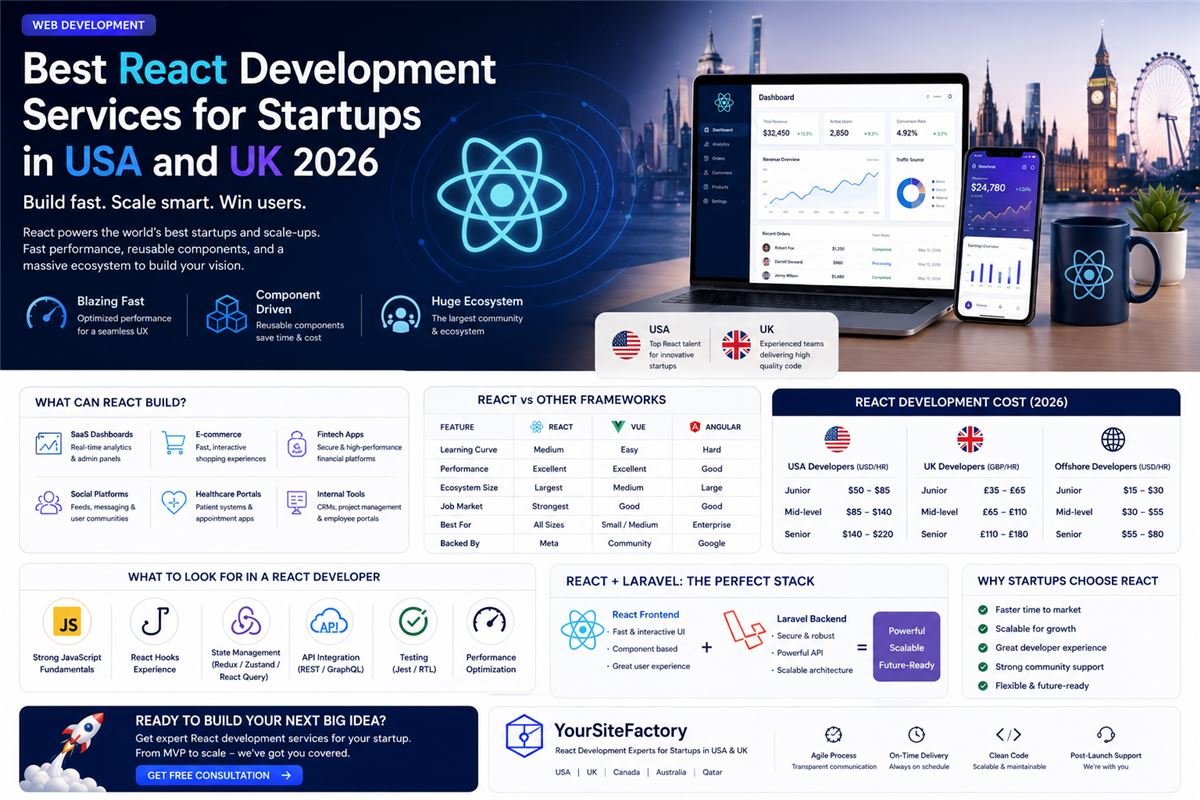
React has become the dominant frontend technology for startups and scale-ups in the USA and UK. From fintech dashboards to SaaS platforms, React powers the interfaces that millions of users interact with daily and for good reason.
If you are building a web application in 2026, understanding React what it actually does, what it costs, how it pairs with backend frameworks like Laravel, and how to hire developers who genuinely know it will save you significant time, money, and architectural regret later.
What Is React and Why Do Startups Choose It?
React is a JavaScript library developed by Meta (formerly Facebook) for building user interfaces. It is not a complete framework it handles the view layer of your application specifically, making it fast, modular, and component-based by design.
This distinction matters. React does not handle routing, state management, or server communication on its own. It does one thing exceptionally well rendering UI components efficiently and relies on the broader ecosystem for everything else. This is a feature, not a limitation. It means you can pair React with exactly the tools your project needs rather than being locked into an opinionated full framework.
Why startups in the USA and UK consistently choose React:
- Performance at scale: React's virtual DOM re-renders only the components that change rather than rebuilding the entire page. Applications built correctly in React feel instantaneous even with complex, real-time data.
- Component reusability: Build a data table, a form, or a notification system once and reuse it across your entire application. For startups moving fast, this reduces development time significantly compared to frameworks that require duplication.
- Ecosystem depth: React has the largest frontend ecosystem in the world. Whatever your application needs drag-and-drop interfaces, data visualisation, PDF generation, real-time updates a maintained, well-supported library exists for it.
- Hiring pool: More developers know React than any other frontend framework. When your startup grows and you need to hire, finding React talent is substantially easier than finding Vue or Angular specialists.
- Investor and buyer recognition: US and UK investors and technical evaluators recognise React as a modern, scalable technology choice. Building on it signals technical competence in a way that niche frameworks do not.
What Can React Actually Build?
- SaaS dashboards: Data-heavy admin panels with real-time updates, charts, filters, and user management
- E-commerce frontends: Fast, interactive product pages, dynamic search, and checkout flows
- Fintech applications: Trading platforms, banking dashboards, payment interfaces requiring sub-second response
- Healthcare portals: Patient management systems, appointment booking, medical record interfaces
- Social platforms: News feeds, messaging interfaces, user profiles with real-time notifications
- Internal tools: Employee portals, CRM systems, project management applications
- SaaS onboarding flows: Multi-step signup processes, interactive pricing configurators, feature tours
The common thread across all of these is interactivity and data. If your application shows users data that changes, lets them manipulate that data, or requires a fast, app-like experience React is the right tool.
React vs Vue vs Angular The Honest Comparison for Startups
| Factor | React | Vue | Angular |
|---|---|---|---|
| Learning curve | Medium | Easy | Hard |
| Performance | Excellent | Excellent | Good |
| Ecosystem size | Largest | Medium | Large |
| Job market | Strongest | Good | Good |
| TypeScript support | Excellent | Good | Built-in |
| Best for | All project sizes | Small to medium | Enterprise |
| Backed by | Meta | Community | |
| Long-term stability | Very high | High | High |
For most startups in the USA and UK, React is the correct choice. Vue is genuinely excellent for smaller applications and has a lower learning curve. Angular is the dominant choice in large enterprise environments where strict typing and opinionated structure reduce team coordination overhead.
If you are a startup that expects to scale, raise funding, or hire developers in competitive markets React gives you the strongest foundation across ecosystem, talent availability, and performance.
How Much Does React Development Cost in 2026?
USA-Based React Developers
| Seniority | Hourly Rate |
|---|---|
| Junior | $50 – $85/hr |
| Mid-level | $85 – $140/hr |
| Senior | $140 – $220/hr |
| Senior at a US agency | $150 – $300/hr |
UK-Based React Developers
| Seniority | Hourly Rate |
|---|---|
| Junior | £35 – £65/hr |
| Mid-level | £65 – £110/hr |
| Senior | £110 – £180/hr |
| Senior at a UK agency | £150 – £250/hr |
Offshore React Developers
| Seniority | Hourly Rate |
|---|---|
| Junior | $15 – $30/hr |
| Mid-level | $30 – $55/hr |
| Senior | $55 – $80/hr |
| Offshore React agency (UK-managed) | $40 – $75/hr |
Project-Based Pricing
| Project Type | Cost Range |
|---|---|
| Simple React frontend (static data) | $3,000 – $8,000 |
| React SaaS dashboard (with API) | $8,000 – $25,000 |
| Full React SaaS application (with Laravel backend) | $20,000 – $80,000 |
| Complex React platform (real-time, multi-tenant) | $80,000 – $200,000+ |
The cost gap between US/UK local developers and senior offshore teams is 60–70% at equivalent seniority levels. For startups with limited runway, this gap is frequently the difference between building an MVP and not building one.
The React + Laravel Stack Why It Dominates SaaS Development
React on its own is a frontend library. It needs a backend to handle authentication, database operations, business logic, email sending, payment processing, and API management. The most effective pairing for startups in 2026 is React on the frontend with Laravel on the backend.
Why this combination works so well:
- Laravel handles everything React does not. Authentication, database migrations, queue workers for background jobs, Stripe subscription billing via Laravel Cashier, API rate limiting, and server-side business logic all handled by Laravel's mature, well-documented ecosystem.
- Laravel's API system integrates cleanly with React. Laravel returns JSON from API endpoints. React consumes JSON. The integration is straightforward and well-documented. Laravel Sanctum handles token-based authentication for React SPAs specifically it is designed for this use case.
- Both have massive communities and long-term support. You are not betting on a niche technology. Both Laravel and React have millions of active developers, extensive documentation, and commercial companies invested in their long-term maintenance.
- The hiring market supports it. A developer who knows both React and Laravel is one of the most employable full-stack profiles in the market. Finding talent, onboarding contractors, or handing off the codebase is straightforward.
This stack is used by thousands of production SaaS products worldwide. It is the default recommendation for any startup building a data-driven web application in 2026.
If you are building a SaaS application on the React and Laravel stack, request a project quote from YourSiteFactory this is our primary delivery stack for US and UK startup clients.
What to Look For in a React Developer
Technical skills that separate real React developers from people who learned React last month:
- JavaScript fundamentals first. A developer who knows React syntax but does not understand JavaScript closures, async/await, event delegation, and the prototype chain will hit walls on any non-trivial project. Test JavaScript fundamentals before testing React knowledge.
- React Hooks fluency. useState, useEffect, useContext, useCallback, useMemo, and useRef they should be able to explain when to use each and why. Overuse of useEffect is a common signal of shallow React knowledge.
- State management judgment. They should know when component state is sufficient, when React Context makes sense, and when a dedicated state manager like Redux Toolkit or Zustand is warranted. A developer who reaches for Redux on every project is not making architectural decisions they are following habits.
- API integration experience. REST and GraphQL consumption, loading states, error boundaries, optimistic updates, and cache invalidation with tools like React Query or SWR. This is where most React applications actually fail in production.
- Performance optimisation. React.memo, lazy loading with Suspense, code splitting, and understanding what causes unnecessary re-renders. In 2026, Core Web Vitals are a Google ranking factor your React application's performance directly affects your SEO.
- TypeScript. Increasingly non-negotiable for production React applications. TypeScript catches entire categories of bugs at compile time that JavaScript misses until runtime.
5 Interview Questions That Expose React Developer Skill Level
1. How do you decide between local component state, React Context, and a state management library like Zustand?
The right answer involves tradeoffs based on data sharing scope and update frequency not a blanket recommendation for one approach.
2. Walk me through how you would optimise a React component that is re-rendering too frequently.
They should mention React DevTools Profiler, React.memo, useCallback for function props, and checking dependency arrays on useEffect.
3. How do you handle loading states and errors when fetching data from an API?
Strong answer mentions React Query or SWR for server state, discusses error boundaries, and addresses the difference between loading states for initial loads versus background refetches.
4. Have you integrated React with a Laravel backend? How did you handle authentication?
They should know Laravel Sanctum specifically for SPA authentication CSRF cookie exchange, token storage security, and handling 401 responses globally.
5. How do you approach testing React components?
Minimum acceptable answer: React Testing Library for component tests, Jest for unit tests, and testing user behaviour rather than implementation details.
Red Flags When Hiring a React Developer
- Uses class components exclusively in 2026 Hooks have been standard since React 16.8 (2019)
- Cannot explain why a component is re-rendering unnecessarily
- Has never used TypeScript and has no interest in learning it
- Manages all application state in a single global Redux store regardless of data scope
- Has no testing experience or dismisses testing as unnecessary overhead
- Cannot show you a live, deployed React application they built themselves
React Development for Specific Industries
Fintech startups (USA and UK): React's performance and the availability of charting libraries (Recharts, Victory, D3) make it the default choice for trading platforms, analytics dashboards, and financial reporting tools. Pair with Laravel for secure API management and audit logging.
Healthcare applications: React's component model handles complex form flows and data display well. For UK NHS-adjacent applications or US HIPAA-compliant systems, the Laravel backend provides the security architecture required.
SaaS products: The combination of React for the interactive dashboard and Laravel for multi-tenancy, subscription billing, and API management is the most proven stack for SaaS MVPs in 2026. Most of the successful SaaS products in the $1M–$10M ARR range were built on this foundation.
E-commerce: React frontends paired with custom Laravel or Shopify backends deliver significantly faster page loads than traditional server-rendered e-commerce directly improving conversion rates and Google rankings.
Frequently Asked Questions
Is React still the best choice for startups in 2026?
Yes for most use cases. Next.js built on React has become the standard for applications requiring server-side rendering or strong SEO alongside interactivity. For pure SPA dashboards behind authentication, React without Next.js remains the most practical choice.
Should I use Next.js or React for my startup?
If your application has public-facing pages that need SEO (marketing pages, product listings, blog content), use Next.js. If your application is entirely behind a login a SaaS dashboard, an internal tool standard React is simpler and sufficient.
How long does it take to build a React SaaS dashboard?
A React SaaS dashboard with authentication, core data tables, charts, and user management takes 6–12 weeks depending on complexity. Paired with a Laravel API, a full SaaS MVP including billing is typically deliverable in 10–16 weeks.
Can React handle real-time features like live notifications or chat?
Yes React pairs with WebSockets via Laravel Echo and Pusher or Ably for real-time features. Live notifications, collaborative editing, and real-time dashboards are all achievable without changing your core React and Laravel architecture.
What is the difference between a React developer and a full-stack developer?
A React developer specialises in frontend UI components, state management, and browser performance. A full-stack developer handles both React on the frontend and a backend framework like Laravel on the server. For most startups, a full-stack developer or a team with combined skills is more practical than separate specialists.
Final Thoughts
React is the right frontend choice for most startups building web applications in the USA and UK in 2026. It is fast, scalable, backed by Meta, supported by the largest developer community in the frontend world, and pairs seamlessly with Laravel for full-stack SaaS development.
The key to getting value from React is hiring developers who understand JavaScript fundamentals deeply, not just React syntax and pairing the frontend with a robust backend architecture from day one rather than bolting one on later.
YourSiteFactory delivers full-stack React and Laravel applications for startup clients in the USA, UK, Canada, and Australia. If you are scoping a SaaS product, a dashboard application, or a custom web platform, view our development pricing or contact us directly for a detailed proposal within 24 hours.