 By
By 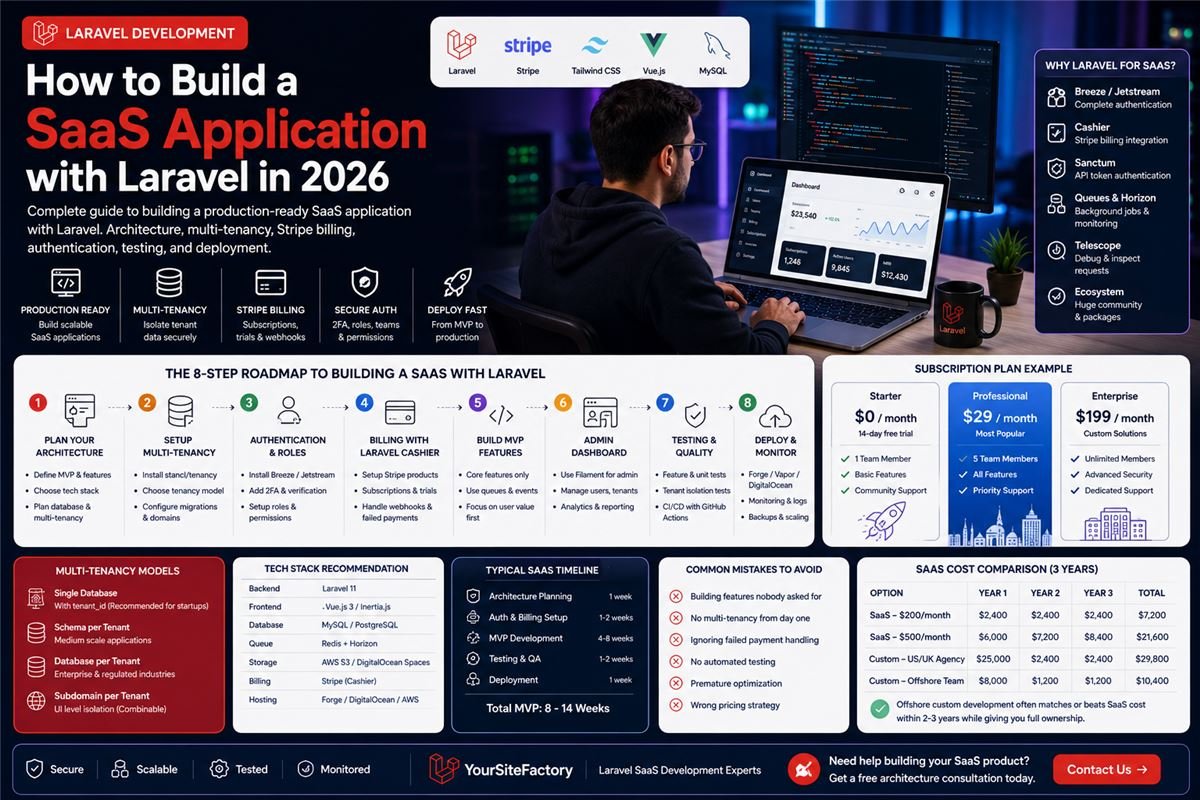
You need software to run your business. You have two options subscribe to an existing SaaS product or build something custom. The wrong choice costs you either a fortune in subscription fees or a fortune in development costs.
This guide gives you a clear, honest framework for making the right decision.
What is SaaS?
SaaS stands for Software as a Service. You subscribe to software built by someone else and access it through a browser. You pay monthly or annually. The vendor handles hosting, updates, and security.
Examples: Salesforce, Slack, Shopify, QuickBooks, HubSpot, Notion, Asana.
Pros:
- Ready immediately
- No upfront development cost
- Vendor handles maintenance and updates
- Proven, tested functionality
Cons:
- Monthly fees forever
- Limited customisation
- Your data lives on someone else's servers
- You are dependent on the vendor's roadmap
- Costs scale with your usage
What is a Custom Web Application?
Custom software built specifically for your business. Designed around your exact processes, owned entirely by you, hosted where you choose.
Examples: A custom CRM for your specific sales process, a booking system designed for your exact service model, an internal operations dashboard built for your workflow.
Pros:
- Built exactly for your needs
- You own the code and data
- One-time build cost
- No per-user or per-feature fees
- Competitive advantage
Cons:
- Higher upfront cost
- Takes weeks or months to build
- You are responsible for maintenance
- Requires a trustworthy development partner
Quick Decision Framework
| Your Situation | Best Choice |
|---|---|
| Standard business function (invoicing, HR, email) | SaaS |
| Unique business process not covered by existing tools | Custom |
| Tight budget, need something now | SaaS |
| Building software as your product | Custom |
| 5+ users all needing the same SaaS tool | Evaluate custom |
| Sensitive data requiring full control | Custom |
| Validating a new business idea | SaaS |
| Outgrowing existing SaaS limitations | Custom |
When SaaS Makes More Sense
Your needs are standard. If existing software covers 80%+ of what you need, use it. There is no business case for building a custom invoicing tool when QuickBooks exists.
You need to move fast. SaaS is live today. Custom development takes weeks to months. If your competitor launches next month, speed matters.
Budget is constrained. $50/month beats $15,000 upfront when cash flow is tight even if custom is cheaper over 5 years.
You are still validating. Do not invest in custom software until you understand your exact requirements. Use SaaS while you learn, then build custom when you know exactly what you need.
When Custom Makes More Sense
Your process is genuinely unique. If your business does something that no existing software handles well, custom gives you competitive advantage that SaaS cannot.
Data ownership is critical. GDPR compliance, data sovereignty requirements, or sensitive business data all point toward custom. Your data on your servers under your control.
You are building a product. If the software IS your business a SaaS you plan to sell you must build custom.
SaaS costs are out of control. Per-seat pricing that made sense at 5 users becomes expensive at 50 users. Run the 3-year numbers.
Deep integration required. Connecting tightly with legacy systems, hardware, or other custom software is much easier with a custom application.
Real Cost Comparison Over 3 Years
| Option | Year 1 | Year 2 | Year 3 | Total |
|---|---|---|---|---|
| SaaS $200/month | $2,400 | $2,400 | $2,400 | $7,200 |
| SaaS $500/month (growing team) | $6,000 | $7,200 | $8,400 | $21,600 |
| Custom US/UK agency | $25,000 | $2,400 | $2,400 | $29,800 |
| Custom offshore team | $8,000 | $1,200 | $1,200 | $10,400 |
Key insight: Offshore custom development often matches or beats SaaS cost within 2–3 years while giving you complete ownership, no vendor dependency, and no per-seat fees.
Industry-Specific Advice
Healthcare: Custom almost always wins. Data privacy requirements, custom patient workflows, and integration with medical systems make off-the-shelf tools inadequate for serious healthcare businesses.
E-commerce: Start with Shopify. Build custom when you outgrow it typically at $1M+ annual revenue when platform fees and limitations become significant.
Professional services (law, accounting, consulting): SaaS for standard tools (practice management, billing). Custom for client portals and anything client-facing that differentiates your firm.
Manufacturing and logistics: Almost always custom. Complex operational workflows, inventory systems, and equipment integration are rarely served well by generic SaaS.
Startups building products: Always custom. Your product is your business.
The Hybrid Approach Best of Both Worlds
The smartest businesses use both strategically:
- SaaS for commoditised functions: Email marketing (Mailchimp), accounting (QuickBooks), HR (BambooHR), project management (Asana)
- Custom for competitive advantage: The part of your operations that makes you different from competitors
This gives you speed and cost-efficiency where it does not matter, and total control where it does.
Questions to Ask Before Deciding
- Does any existing SaaS cover at least 80% of what I need?
- What is my 3-year total cost for each option?
- How important is data ownership for my business?
- Am I building a product or buying a tool?
- How long can I wait before having something working?
- What happens to my business if the SaaS vendor raises prices or shuts down?
- Do I have unique processes that give me competitive advantage?
FAQ SaaS vs Custom Web App
Is custom software always more expensive than SaaS?
Not over the long term. A $8,000 offshore custom build often costs less than 3 years of SaaS subscriptions for the same functionality while giving you ownership and flexibility.
How long does it take to build a custom web application?
Simple applications take 4–8 weeks. Complex business applications take 3–6 months. The timeline depends on feature complexity, not just the number of pages.
What if my requirements change after building custom software?
Custom software can be updated and extended. A good development partner builds with future changes in mind. SaaS products may or may not add the features you eventually need.
Is my data safe in a SaaS product?
Reputable SaaS vendors invest heavily in security. But you have no control over their infrastructure, their employees' access to your data, or what happens if they are acquired or shut down.
Can a small business afford custom software?
Yes. Working with offshore development teams makes custom software accessible to small businesses. YourSiteFactory builds custom web applications starting from $3,000 comparable to 1–2 years of many SaaS subscriptions.
Which is better for GDPR compliance?
Custom gives you complete control over data storage, processing, and deletion making GDPR compliance easier to implement and document. SaaS compliance depends entirely on the vendor.
Final Thoughts
SaaS vs custom is not a question of which is better. It is a question of which is better for your specific situation, budget, and goals.
Use SaaS when your needs are standard and speed matters. Build custom when your process is unique, your data is sensitive, or your SaaS costs are scaling faster than your revenue.
Not sure which is right for your situation? Contact YourSiteFactory for a free 30-minute consultation. We will give you an honest recommendation even if that recommendation is to use an existing SaaS product instead of hiring us to build something custom.