 By
By 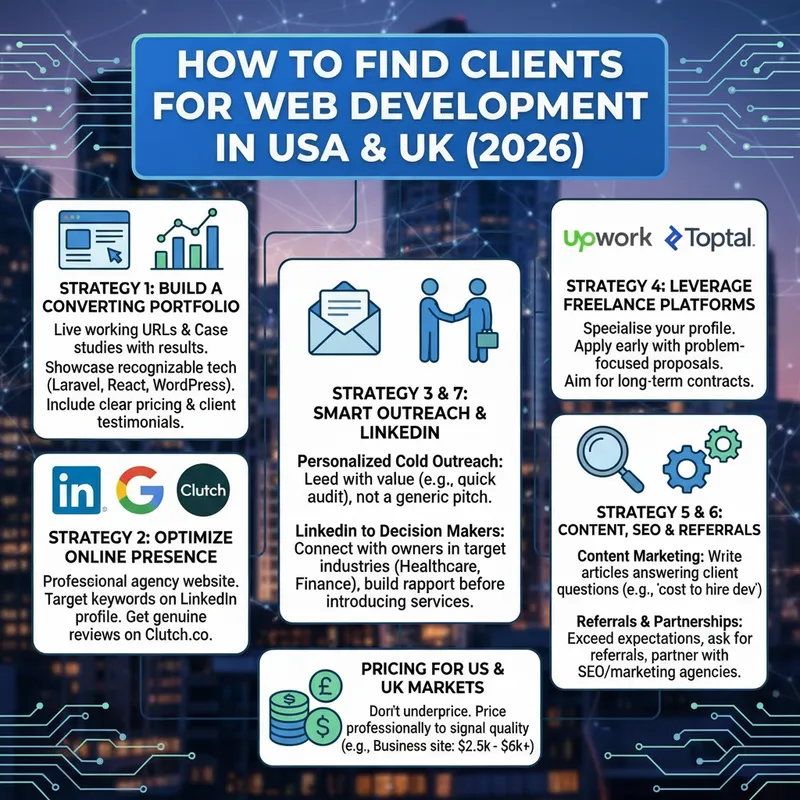
Getting clients is the hardest part of running a web development business. You can be an exceptional developer fluent in Laravel, React, and modern DevOps practices and still struggle to find consistent work if you do not know where to look and how to present yourself to the right buyers.
This guide is specifically for web developers and agencies targeting the USA and UK the two most lucrative English-speaking markets for web development services. Every strategy here is actionable in 2026, not theoretical advice recycled from five years ago.
Why USA and UK Are the Right Markets to Target
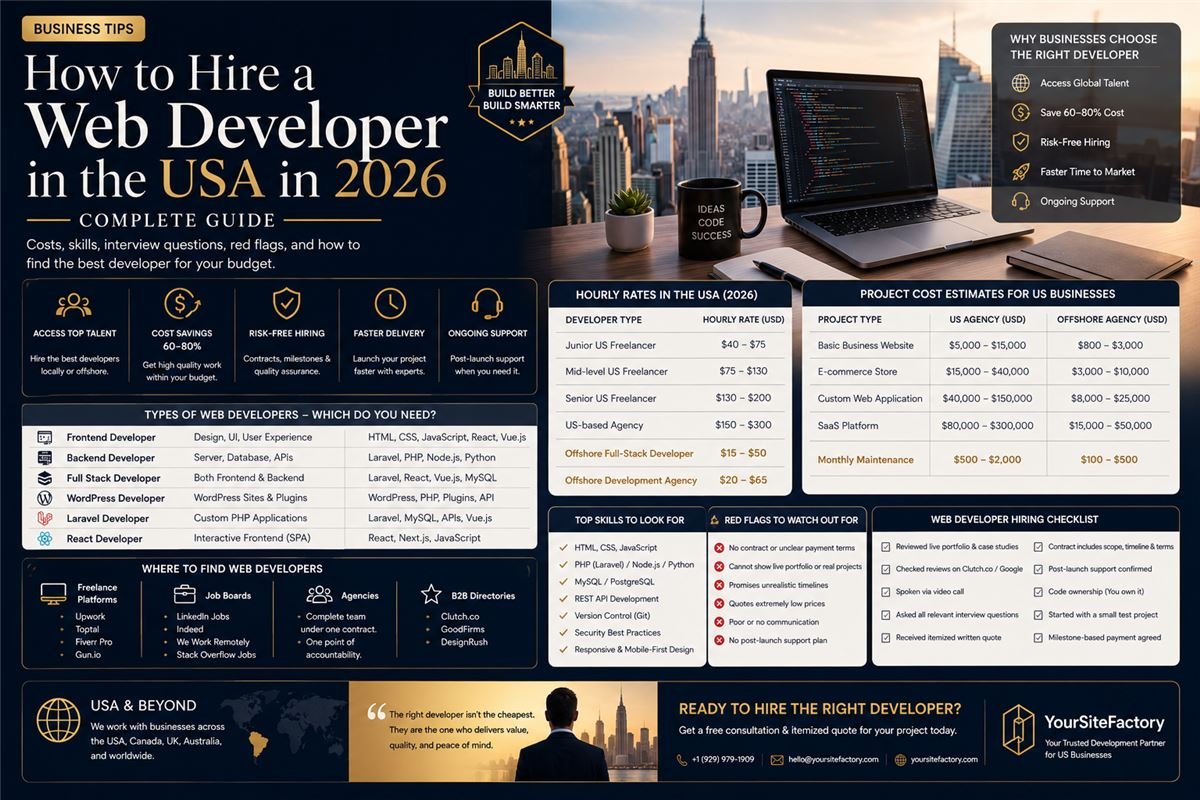
United States: The world's largest economy with the highest willingness to pay for quality digital work. American businesses invest heavily in web development, are comfortable working with international teams, and make purchasing decisions faster than most other markets. A senior Laravel developer in the US market commands $130–$220/hr making offshore quality teams enormously attractive to American buyers on a budget.
United Kingdom: Strong tech sector, high digital adoption, and a business culture that values long-term relationships with reliable partners. UK clients pay professional rates and tend to stay with agencies they trust. Senior UK developers charge £400–£700/day creating the same offshore value proposition that works in the US market.
Both markets communicate in English, are culturally accustomed to working with offshore development teams, and actively search online for development partners. They are the ideal targets for agencies based in Pakistan, India, Eastern Europe, or anywhere with strong technical talent and lower operating costs.
Strategy 1 Build a Portfolio That Converts US and UK Buyers
Your portfolio is your most powerful sales tool. A generic portfolio with screenshots and technology logos does not convert. US and UK buyers are sophisticated they have been burned by cheap agencies before and they know what to look for.
What US and UK clients actually want to see:
- Live working websites with real URLs they can click and test
- Case studies that show business outcomes not just what you built but what it achieved
- Testimonials from named clients with company names anonymous testimonials are ignored
- Technologies they recognise and trust: Laravel, React, WordPress, Shopify, Python
- Evidence of how you handle problems, not just how you handle smooth projects
How to build a credible portfolio quickly:
- Build 3–5 spec projects for fictional companies that demonstrate real technical depth a multi-tenant SaaS demo, a Laravel API with React frontend, a WooCommerce store with custom functionality
- Offer free or heavily discounted work to 2–3 real businesses in exchange for named testimonials and permission to display the work
- Rebuild an existing poorly-built website and document the before-and-after with performance metrics
- Contribute to open source Laravel packages on GitHub this demonstrates technical credibility to developers who evaluate agencies
The critical mistake to avoid: Listing 20 projects with no context. Three excellent case studies with business outcomes beat twenty screenshots every time.
Strategy 2 Build an Online Presence That Targets Your Specific Markets
Before doing any outreach, your digital presence must be professional and specifically positioned for US and UK clients. Generic agency websites that say "we build websites" do not convert international buyers.
Your agency website:
Your website is your silent salesperson working 24 hours a day. It must clearly state that you work with US and UK clients, show relevant portfolio work, include transparent pricing ranges, and have a contact form that responds within 24 hours. If your website looks like it was built by someone learning web development, US and UK clients will not trust you to build theirs.
LinkedIn:
Update your profile headline to target your specific market. Examples that work:
- "Laravel Developer for US SaaS Startups Fixed-Price Projects"
- "Web Development Agency for UK Small Businesses Laravel & React"
- "Senior Full-Stack Developer Specialising in US E-Commerce Clients"
These keyword-specific headlines appear in LinkedIn search results when buyers search for development help.
Clutch.co:
This is the single most important platform for B2B web development services. US and UK procurement teams check Clutch before shortlisting any agency. Even 3–5 genuine verified reviews on Clutch can completely transform your inbound lead flow. Prioritise getting your first Clutch reviews above almost every other marketing activity.
Google Business Profile:
Create a profile and optimise it for your target services. Even as an offshore agency, you can appear in relevant searches. Use service keywords like "Laravel development agency" and "custom web application development" in your profile description.
Strategy 3 Cold Outreach That Actually Gets Responses
Cold outreach works when it is specific, personalised, and leads with value. Most developers do it wrong they send generic templates about their services that get deleted in under three seconds.
Finding the right prospects:
- Search LinkedIn for "founder" or "CEO" at companies with 10–50 employees in your target industries
- Search Google for businesses in specific US cities or UK towns that have outdated websites slow load times, non-mobile-responsive layouts, or designs that look five years old
- Check Crunchbase and AngelList for recently funded startups they have money and need development immediately
- Look at local business directories in target cities for service businesses (law firms, medical practices, real estate agencies) that typically have poor websites
The outreach message that generates responses:
Do not pitch in your first message. Lead with something specific and valuable. This template consistently generates responses:
"Hi [Name], I was looking at your website and ran a quick speed test it loads in 7.3 seconds on mobile. I put together a 3-point audit showing exactly what is causing it and how to fix it. No pitch, no strings attached just thought it might be useful. Happy to send it over?"
This works because it is specific (7.3 seconds not "your website is slow"), it leads with value rather than a request, and it asks a low-commitment yes/no question.
Follow-up sequence:
- Day 1: Initial message with specific observation
- Day 4: Short follow-up sharing one additional insight
- Day 8: Final message offering the audit whether they respond or not
- After Day 8: Move on do not chase beyond three touches
Strategy 4 Freelance Platforms as a Starting Point
For early-stage agencies and freelancers, platforms like Upwork are a valid starting point despite their fees. The mistake most developers make is treating these platforms as a long-term business model rather than a client acquisition channel for building initial reviews and case studies.
Winning on Upwork:
- Specialise your profile aggressively "Laravel Developer for SaaS Startups" beats "Web Developer" in search ranking and in buyer confidence
- Apply within the first hour of a job being posted early proposals get significantly more attention
- Write proposals that open with the client's specific problem, not your credentials
- Start with competitive rates, deliver exceptional work, collect five-star reviews, then raise rates by 20–30%
- Target long-term contracts over one-off gigs a $500/month retainer is worth more than a $2,000 single project
Other platforms worth using in 2026:
- PeoplePerHour UK-focused, strong for targeting British clients specifically
- Toptal rigorous vetting but significantly higher rates once accepted
- Codeable WordPress-specific, consistent demand from US and UK clients
- Gun.io US-focused, better quality clients than general Upwork
Strategy 5 Content Marketing and SEO (The Highest ROI Long-Term Strategy)
This is the most powerful client acquisition strategy available to web development agencies in 2026 and the most underused. When a business owner in Chicago searches "hire Laravel developer USA" or a startup founder in London searches "web development agency for SaaS UK," you want to appear on page one.
The content that attracts US and UK buyers:
Write articles targeting the exact questions your ideal clients type into Google:
- "How much does a website cost in the UK in 2026?"
- "How to hire a web developer in the USA"
- "Laravel vs WordPress which should I use?"
- "How much does custom software development cost in the USA?"
- "How to hire a Laravel developer in the UK"
These are not random topics. They are the exact search queries that bring buyers to your website passively 24 hours a day, without any outreach or advertising spend.
Why this works better than cold outreach:
A person who finds your website by searching "how to hire a Laravel developer UK" is already looking for what you offer. They are not being interrupted they came to you. Conversion rates from organic search traffic are 3–5 times higher than cold outreach.
The content strategy that works:
- Publish one well-researched, 1,500–2,500 word article per week targeting a specific buyer question
- Include real pricing data buyers trust content that gives specific numbers
- Add internal links from blog posts to your pricing and contact pages
- Submit each new post to Google via the Indexing API for faster indexing
Results from content marketing take 3–6 months to materialise but compound indefinitely. A blog post published today can generate leads for the next three years.
Strategy 6 LinkedIn Outreach to Decision Makers
LinkedIn is the most effective platform for reaching business decision makers in the USA and UK. The key difference between LinkedIn outreach that works and LinkedIn outreach that gets ignored is relationship-first versus pitch-first.
The sequence that works:
- Connect with small business owners, CTOs, and marketing directors in your target industries no message needed on the connection request
- After connecting, engage genuinely with their content for 1–2 weeks thoughtful comments, not emoji reactions
- Send a value message referencing something specific from their profile or recent posts not a pitch
- After building minimal rapport, introduce your services in the context of a problem they have mentioned
Industries that consistently pay well in USA and UK:
- Healthcare and medical practices HIPAA-compliant portals, patient management systems
- Legal firms case management tools, client portals
- Real estate agencies property listing platforms, CRM integrations
- Financial services dashboard applications, reporting tools
- E-commerce brands custom Shopify or Laravel storefronts
- SaaS startups the highest-value clients for Laravel agencies specifically
Strategy 7 Referrals and Strategic Partnerships
Your best clients come from referrals. A referred client arrives with trust already established they convert faster, negotiate less on price, and are more likely to become long-term clients themselves.
Maximising referrals from existing clients:
- Always exceed expectations on the first project the first delivery sets the relationship tone for everything that follows
- Ask explicitly most satisfied clients will refer if asked directly. "Do you know anyone else who might need something similar?" is a question most developers never ask
- Create a referral incentive one month free maintenance, a discount on the next project, or a cash referral fee for introductions that convert
- Follow up with past clients every 6 months not to pitch but to check in and share relevant insights
Strategic partnerships that generate consistent leads:
- SEO agencies they have clients who need websites built or rebuilt
- Graphic designers they create brand identities but cannot build websites
- Marketing consultants they recommend development partners to their clients regularly
- Accountants and business advisors their clients frequently ask for web development recommendations
A single good partnership with an SEO agency can generate more leads per month than dozens of cold outreach messages.
Pricing for US and UK Clients Do Not Underprice
This is the mistake that costs offshore agencies the most revenue and the most credibility. US and UK clients expect professional rates. They have been burned by suspiciously cheap agencies and have learned to associate very low prices with poor outcomes.
Minimum pricing benchmarks for US and UK markets:
| Project Type | Minimum Price (USD) | Minimum Price (GBP) |
|---|---|---|
| Basic business website | $2,500 | £1,800 |
| Professional business website | $5,000 – $10,000 | £3,500 – £7,000 |
| E-commerce store | $5,000 – $20,000 | £3,500 – £15,000 |
| Custom web application | $10,000 – $50,000 | £7,000 – £35,000 |
| Laravel SaaS MVP | $15,000 – $60,000 | £10,000 – £40,000 |
| Monthly retainer | $500 – $2,000 | £350 – £1,400 |
Pricing below these ranges signals low quality regardless of your actual skill level. US and UK buyers use price as a proxy for quality when they cannot evaluate technical ability directly. Price at the lower end of professional rates while you build reviews and case studies but never below professional rates.
Frequently Asked Questions
How long does it take to land the first US or UK client?
With consistent effort across 2–3 of the strategies above, most agencies land their first US or UK client within 60–90 days. Upwork is the fastest path 2–4 weeks with strong proposals. SEO and content marketing take 3–6 months but produce higher quality inbound leads.
Do US and UK clients care that my agency is based offshore?
Less than they did five years ago. What they care about is communication quality, English proficiency, timezone overlap, proven portfolio work, and on-time delivery. Address these concerns proactively and location becomes a secondary concern.
What is the best platform to find UK web development clients?
Clutch.co for agency credibility, PeoplePerHour for direct project work, and LinkedIn for outreach to decision makers. For inbound leads, SEO-optimised content targeting UK-specific queries is the highest ROI channel.
Should I specialise in a technology like Laravel to find clients?
Yes unambiguously. A specialist Laravel agency for SaaS startups wins against a general web development agency in almost every competitive situation. Specialisation commands higher rates, attracts better clients, and makes your marketing significantly more targeted and effective.
How do I get my first Clutch review?
Ask your first satisfied client directly. Clutch sends a verification email to the client and conducts a brief phone interview. The process takes 15 minutes for the client. Most satisfied clients will complete it if you ask clearly and explain why it matters to your business.
Final Thoughts
Finding clients in the USA and UK requires consistency, professionalism, and patience. No single strategy produces results overnight. The agencies that build sustainable client pipelines combine a strong online presence that positions them specifically for Western markets, targeted outreach with genuine value leads, content marketing that brings buyers to them passively, and exceptional delivery that generates referrals.
Start with two strategies rather than attempting all seven simultaneously. If you are early stage, combine Upwork with LinkedIn outreach. If you have existing clients, combine referral maximisation with content marketing. Add strategies as each one gains traction.
YourSiteFactory has been serving US and UK clients since our founding. If you are a business in the USA or UK looking for a reliable Laravel and web development partner with transparent pricing, request a project quote or view our pricing structure we respond within 24 hours.